

Last week, Michael Kratsios (head of the US Office of Science and Technology Policy) dropped a 123-page banger of a report called SCIENCE: A New Golden Age. If the last few years for American science have felt a little like an “it’s so over” spiral, this report is doing its level best to argue we might instead be “so back”.

It’s the most serious exec-level rethink of how America does science since Vannevar Bush’s 1945 version instigated the creation of the NSF, and if even half of what it proposes actually happens it will completely reshape the roughly $200 billion a year the federal government spends on R&D. As our current president would say, yuge!
Though with this administration it’s perhaps more accurate to say “yuge if true” and IMO there are two things we have to consider before we get too excited:
First, OSTP is a policy-coordinating body without direct budget authority over NIH, NSF, DOE, or literally anyone else so as cool as this document might be, it’s only as powerful as the agencies and Congress choose to make it.
Second, this administration has been actively working against the interests of American science in many cases (a gap I’ll come back to with far less restraint in the lowlights section of this piece).
That said, the ideas it contains are worth engaging with anyway because many of them are pretty good, because they may well outlive the political weather du jour AND because it’s fun to get nerdsniped by compelling visions of humanity’s technological future. I highly recommend you read the whole thing but if you’re feeling a little like “I ain’t reading all that” you’re in luck because I’ve summarized some of my thoughts on it below.
Some of the highlights
AI is massively changing what individual scientists can do. In the bull case, one Very Smart Science Human could in theory direct a whole gaggle of specialized AI agents and autonomous instruments alongside external collaborators to produce wild outlier results, which implies that the most relevant scientific skill of the next decade may be scientific taste rather than technical ability. In some places this shift from “can you personally do the technical work” to “can you ask the right questions and know which outputs to trust” is already happening:
The report cites the 2024 Nobel Prize in Chemistry which went to Demis Hassabis and John Jumper (for AlphaFold2) and David Baker (for computational protein design that AlphaFold enabled him to accelerate). Before AlphaFold, resolving a single protein structure took months to years of x-ray crystallography and cryo-EM work. AlphaFold has since predicted the structures of more than 200 million proteins and has meaningfully transformed what a structural biologist can attempt in a career.
An example I love that isn’t in the report is the scientific literature itself: there are like 40 million papers on PubMed, which is not a corpus any individual human is going to read, so FutureHouse released a public platform of AI agents that can perform literature search and experiment planning at benchmarked superhuman levels on some scientific tasks. In May 2025 their multi-agent system Robin identified ripasudil as a candidate treatment for dry age-related macular degeneration, a leading cause of irreversible blindness. Humans ran the wet lab to test the hypothesis but they soon may not need to thanks to…
…the Genesis Mission, which is the blockbuster AI-for-science piece of the doc and proposes billions of dollars of investment into closed-loop autonomous experimentation, AI-ready dataset curation, foundation models trained on the government’s scientific data, and even a rebuild of the scientific instruments industry itself because our lab equipment ships with proprietary data formats and vendor-lock software that make automated workflows a nightmare. (This was true even a decade ago back when I decided to move to NYC to help build the open-source hardware layer for life science labs with Opentrons).
Competing with China is the organizing frame. The words “dominance,” “leadership,” “critical and emerging technologies / CET,” and “national security,” appear a collective 78 times across the report’s 123 pages which makes every proposed reform feel like it’s being pitched to ensure American scientific leadership in the face of a specific competitor (namely, China). I recently went on one of those Bay Area hikes that’s less about recreation than it is about spending three hours talking Chinese geopolitics with a bunch of operators and investors. The highlight was a discussion around what feels like an intentional shift in Chinese R&D posture, where the playbook used to be pretty explicitly fast-follow focused: let someone else spend a decade and a billion dollars validating a technology, then iterate on it faster and cheaper than the originator, then ???, then profit (e.g. don’t be Tesla, be BYD; don’t be Apple, be Huawei; don’t be Moderna, be Innovent). But the “US innovates, China imitates” framing feels increasingly wrong given China’s R&D spend has climbed from 72% to 96% of US levels on a PPP basis over the last decade, and they now file nearly half of all patents on Earth (1.8 million applications in 2024, more than three times the US total). With the usual caveats that quantity definitely isn’t quality, the direction of travel is unambiguous.
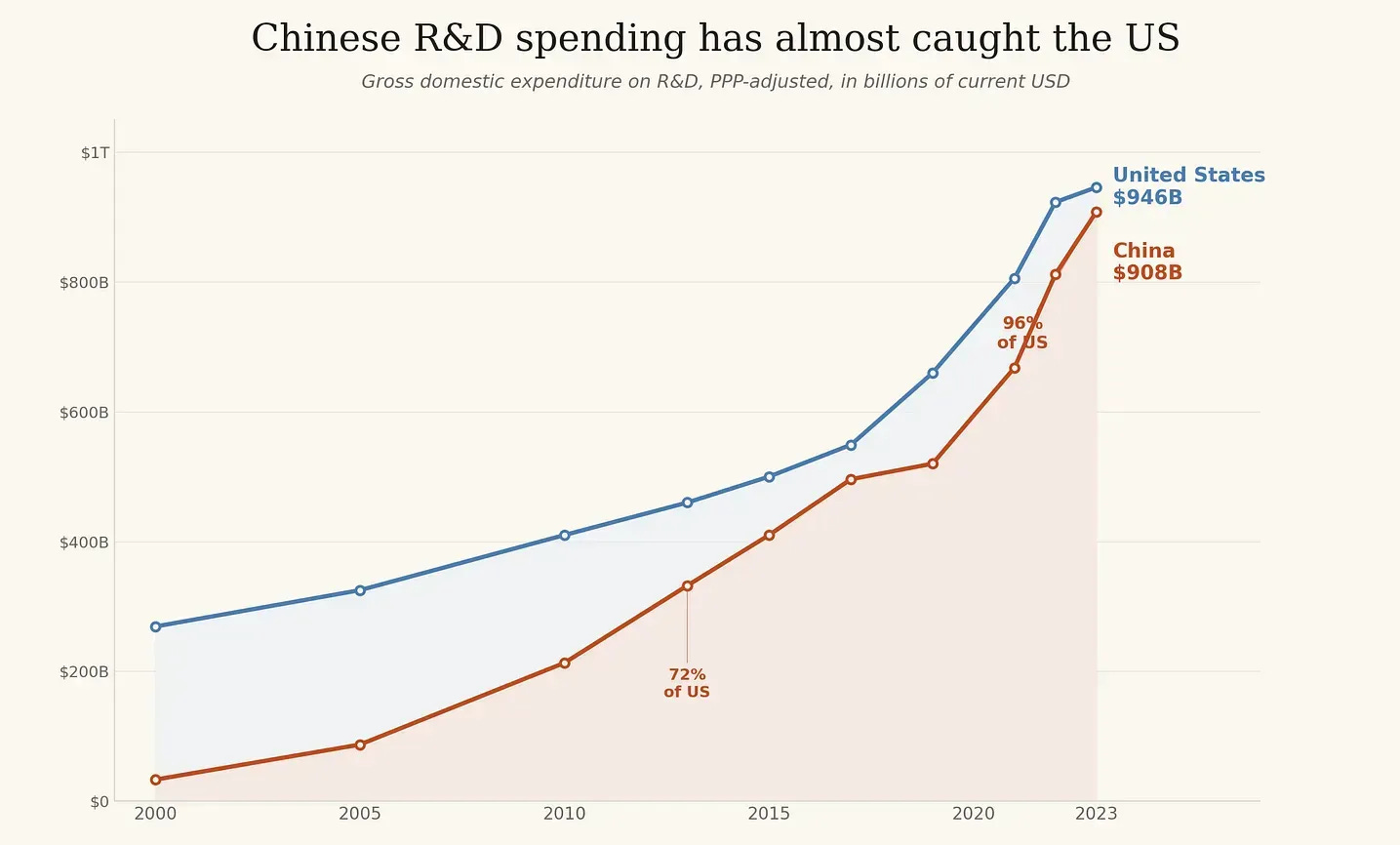
Source: OECD MSTI (published March 2025, data analyzed through 2023) A few other contextual things worth noodling over:
On AI specifically, China produces the most AI publications and total citations of any country and the performance gap between the leading US and Chinese frontier models has narrowed: just last week Chinese lab Moonshot dropped Kimi K3, the largest open-weight AI model in the world (2.8 trillion parameters), which took the #1 slot in Frontend Code Arena away from Anthropic’s Claude Fable 5. Also anyone can download and run it (which is not to say they should… caveat emptor, obviously).
Even in biotech where the US has long been the dominant innovator, experts like Franklin Templeton’s Evan McCulloch have visited dozens of Shanghai biotechs and come home convinced that China now has the R&D depth and clinical infrastructure to originate first-in-class assets rather than chase them.
That said, the US still has an edge on innovation and the report argues American science has an opening to reunite our world-leading R&D with domestic manufacturing in biotech, semiconductors, drones, shipbuilding, and nuclear to ensure our position in the global tech race, especially if the lion’s share of near-future federal science funding gets pointed at the CET list (AI, quantum, autonomy, microelectronics, hypersonics). The vision for this is very Big If True; guess we’ll see how it goes!
We’re rethinking the science of how science gets done. For a full human lifespan American science funding has routed basic research from federal grant-making agencies (mostly NIH and NSF) through university labs and then into industry in an approximately straight (but often broken) line. Kratsios argues that modern scientific leaps are now more centered around Pasteur's quadrant: research that is both use-inspired AND driven by a quest for fundamental understanding, much like Pasteur himself figuring out why wine spoiled (which was also the origin of microbial theory of disease). At Convergent Research we tend to agree with this frame and think that a lot of the highest-leverage scientific work will be in building foundational tools and infrastructure (like barcoding and expansion microscopy) that enable us to peer further into structural field-level gaps and ask even more interesting questions downstream.
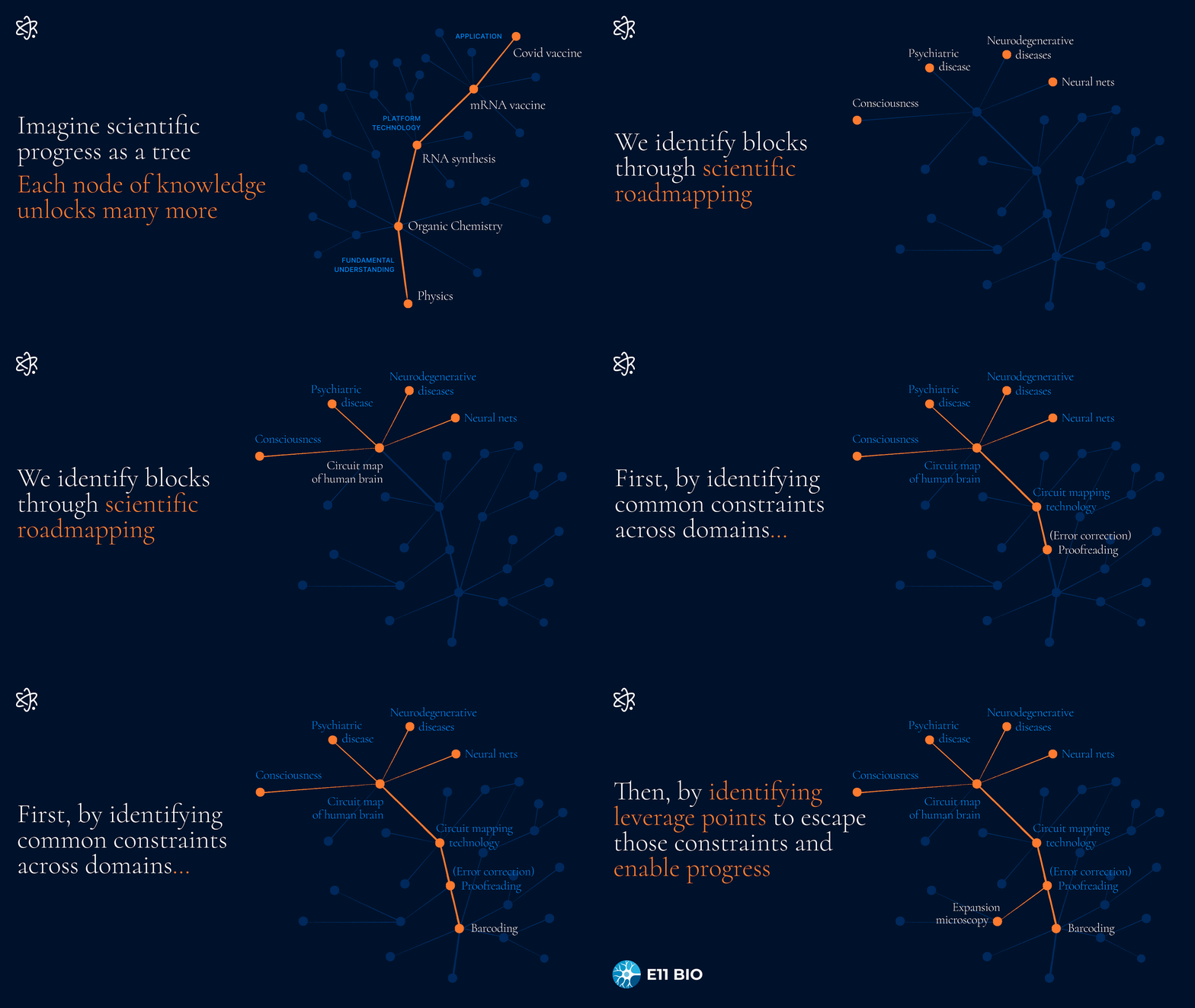
How Convergent thinks about bottlenecks and the technologies that solve them. The deeper thesis beneath all of this is that we should be running experiments on how we fund and organize science via a discipline called metascience (this will become a mainstream buzzword soon): it’s basically the science of improving how science gets done. Two big parts of the report get at this:
First, it proposes that every federal agency should get a dedicated metascience unit with a protected budget and authority to run controlled experiments on the review process itself, modeled on the UK’s Metascience Unit and intellectually grounded in Michael Nielsen and Kanjun Qiu’s A Vision of Metascience.
Second, it highlights an expansive hypothetical menu of grant mechanisms, like golden tickets that let individual reviewers champion an ambitious proposal past a consensus panel, fast grants with turnaround measured in weeks rather than years, regranting that delegates funding authority to trusted scientists, and more Vesuvius-style prize challenges and advanced market commitments that pay for outcomes rather than plans. This is, to me, the most fun and interesting part of the report, and I look forward to thinking about how it plays alongside the coming third wave of American philanthropy.
Speaking of new ways of doing science, FROs are SO HOT right now. Convergent builds Focused Research Organizations (time-bound, nonprofit research startups engineered to break specific scientific bottlenecks and then dissolve), which get a substantial nod in the report’s “novel performers” framework. The OG FRO proposal from Sam Rodriques and Adam Marblestone (2020) is cited, as is the Gap Map which catalogues fundamental development bottlenecks across dozens of scientific fields (and should be considered among the most useful working documents about what’s actually blocking scientific progress). We’re all pretty stoked about this!

NSF’s X-Labs program, launched by the TIP Directorate, is pitched as the federal proof-of-concept for the FRO model (and of course, we’re helping exceptional scientific teams apply). The report also endorses ARPAs and a general Cambrian explosion of “novel performers” beyond the PI-led academic lab. Universities will still have a strong place in training scientists and advancing basic research, but will also need to adapt to a more flexible and iterative model for progress.
The “paperwork tax” is bad and we should fix it. Some federal grants take nearly two years from submission to award, which the report notes is roughly how long it took to design and produce the first Boeing 747. Scientists spend around half their federally funded research time on paperwork (!!!); meanwhile, researchers at NIH-funded institutions accept effective indirect cost rates above 40%. These numbers and others have been floating around the metascience discourse for years, but seeing them in a document with a presidential seal on the front feels like it could maybe shift the conversation into real action.

Some of the lowlights
The spirit of the report and the practices of the current administration are in direct conflict. The report wants the federal government to attract global talent and stabilize funding for working scientists, and the administration that commissioned it has spent its entire tenure doing the opposite. The FY 2026 budget request proposed to cut NIH by roughly 37% and NSF by more than 50%, along with eliminating most federal spending on climate and ecological research. Meanwhile nearly 2,000 NSF grants were cancelled or suspended. Indirect-cost bloat exists, per the “paperwork tax” point above, but the administration’s solutions to that problem have been wildly antagonistic and indistinguishable from “gutting all of science”. We need stable support for science overall and that still includes the infrastructure we’ve already built around university & academic research, independent peer review, and attracting top scientific talent from all over the planet.
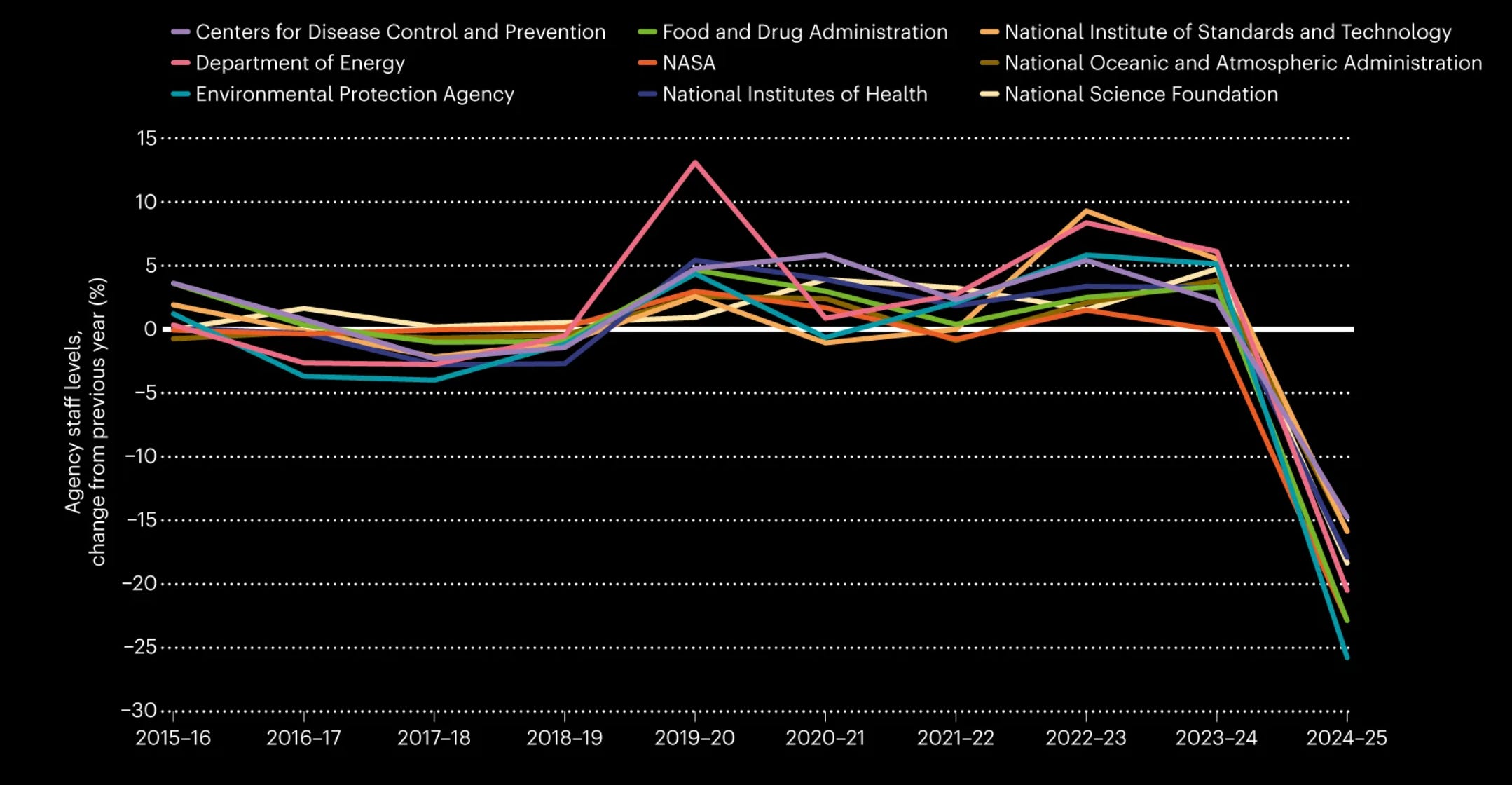
Speaking of talent, by November 2025 the administration had revoked roughly 8,000 student visas, new international student enrollment had dropped 17% year-over-year, and Harvard cut science PhD slots by 75% while Cornell rescinded more than half of its chemistry PhD offers. The OSTP report says America should out-compete China for scientific talent but the pipeline we need to meet that ambition is being actively gutted by the current admin. Federal science agencies lost about 20% of their staff in 2025 relative to the previous year; meanwhile talented researchers from both government agencies and universities are leaving for Germany, the UK, and Canada in droves. We’re basically shooting ourselves in both feet right now, and we need to reverse course fast before we lose our edge.
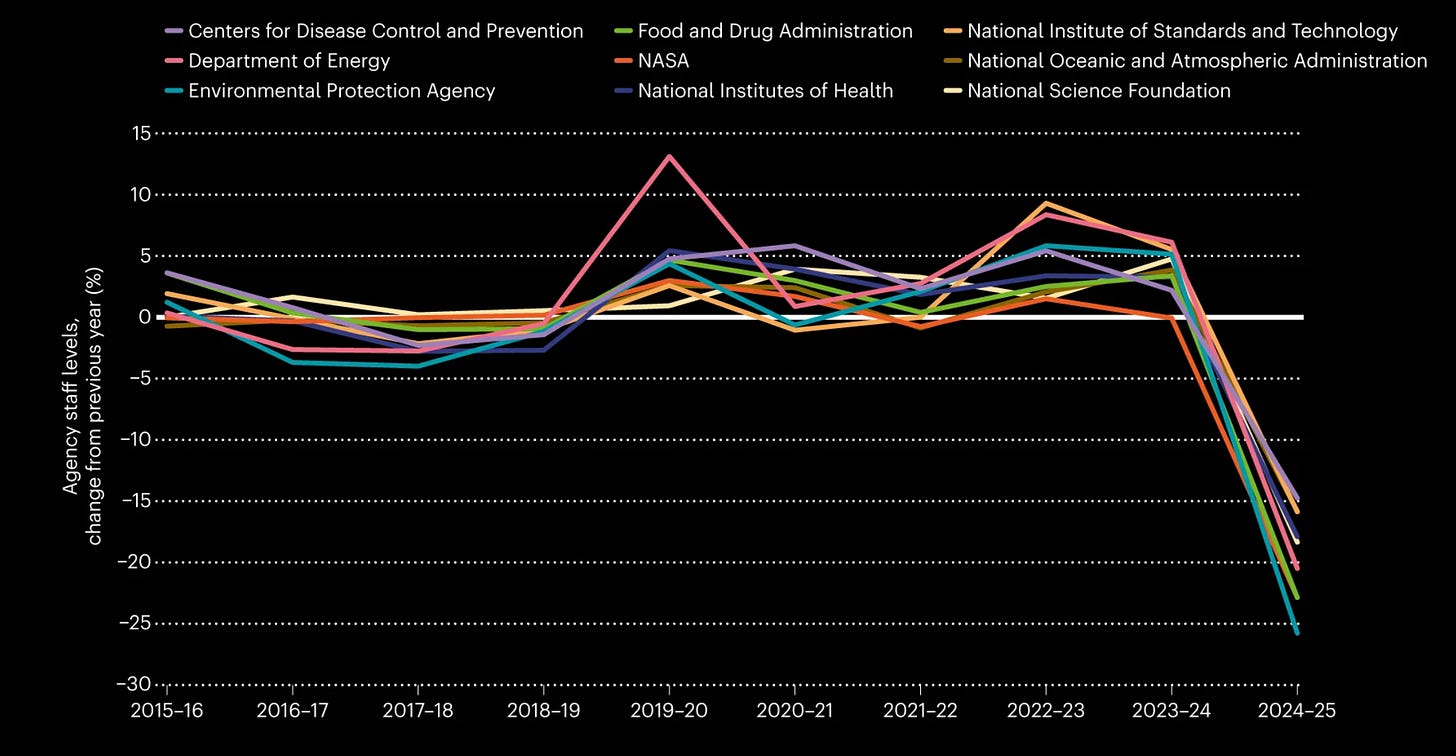
Source: Nature, “US Science After A Year of Trump” Biosecurity is completely missing. The report treats biotech as a category the US needs to win (yes, correct, nods emphatically) but winning at biotech and doing biosecurity are two different problems, and the report really only handles the first one. It’s worth noting I don’t mean “biosecurity” as in “how do we stop LLMs from walking a disgruntled postdoc through synthesizing smallpox in his mom’s basement” (a real concern, but also harder than the doomer framing suggests). I mean the boring infrastructural stuff: dual-use research of concern, pandemic preparedness capacity, pathogen surveillance, biosafety lab governance, etc, all of which are areas where America is currently substantially under-invested, and all of which are where the next COVID-scale event will hurt most. The words “synthetic biology” appear exactly once in the whole report, in a paragraph about test infrastructure for commercial deployment. This is a weirdly big gap in a document that is otherwise built around an explicit national security throughline and is trying to be a serious blueprint for the next 20 years of American science, especially given biosecurity has historically been within OSTP's coordinating scope.
We’re still ignoring the climate. Though this report was published against a backdrop of record global heat and extreme weather events, the word “climate” appears mostly in the context of energy technology rather than as an object of scientific study or engineering gap worthy of its own broad consideration. This after the FY 2026 budget request proposed to zero out most federal climate research! This is very stupid, and will expose us to severe national security and supply chain risks if we do not pay attention and reverse course. (I wrote about this recently, and likely will again soon).
The slop problem. AI amplifies whatever it’s trained on, so whether AI accelerates science or accelerates the enshittification of science depends on whether the verification infrastructure (reproducibility standards, curated open datasets, metascience units, machine-auditable replication packages) gets built alongside the generation infrastructure. To its credit, the report does highlight this as a concern, which it cites via Sayash Kapoor and Arvind Narayanan’s essay “Could AI Slow Science?”. Their analogy landed sharply for me as a climate gal: for a century the US aggressively suppressed forest fires and prevented small burns, which allowed fuel to accumulate until the fires became infernos. AI could do the same thing to science by making each individual researcher seemingly more productive while allowing the conditions for systemic dysfunction to build into something of a runaway catastrophe.
So… what happens now?
The best-case read of A New Golden Age is, it’s a thoughtful blueprint whose ideas will outlast the administration that commissioned it. The worst-case read is, it’s intellectual cover for a set of policies doing the opposite of what the report recommends. If the reforms happen and the massive cuts don’t, we get a bonafide scientific Golden Age (heck yeah, roll tide, cue the national anthem and the screeching eagles). If the cuts happen and the reforms don’t, we’ll get a lot of shuttered labs with an articulate and nicely-kerned policy document sitting on top of them.
It’s worth flagging that even in a perfectly-aligned administration, it would be hard to predict where this will end up given major technological leaps are now happening monthly rather than on a decadal timescale (did you see the guy who used an LLM to make the first meaningful progress in a decade on the Jacobian Conjecture??! our noses are very much squished against the exponential curve right now). Regardless, this is an incredibly exciting moment for those of us who actually work in science and/or the adjacent supporting infrastructure for it.
I’d still cautiously-optimistically put money on this becoming the most consequential document about how America will do research since its prequel (Vannevar Bush’s epoch-defining report SCIENCE, The Endless Frontier, which was written when “high performance computing” meant a room full of women doing math by hand). That report convinced the federal government to fund basic research at all and shaped roughly every taxpayer dollar that went into American science for the following 81 years despite the fact that Truman vetoed the first bill implementing it.
Every institutional bet in this report might not actually garner bipartisan support, but it nonetheless signals that our appetite for doing hard things is clearly So Back and my favorite thing about it is that it will no doubt inspire the builders. But the gap between the words on those 123 pages and the actions we take to fulfill their very lofty goals is the story to watch… stay tuned!12

Thanks to Ramez Naam, Clay Dumas, Jay Lewis and Adam Marblestone for comments. If you enjoyed this piece, please like / share / subscribe; if you didn’t, please argue in the replies.
As always, come talk to me if you want to brainstorm how to unblock yuge bottlenecks in science. :)
First -- thank you very much Kristin for creating this excellent overview. I fully agree with most of your analysis.
Second -- it seems to me that a big internal contradiction in the Kratsios report is between two main premises. One is "America First" -- foreign students are security risk, international collaboration is a giveaway. etc. The other is the push towards AI-based framework -- which is as globalist as one could imagine. I am not sure how to reconcile these two ideas in one brain.
Third -- the report assumes that science is an appendage to market, technology, or state security. Not even once "curiosity-driven research" is mentioned. In the old days, scientists worked on a problem because they were excited about it, often because they viewed it as a service to their Creator. Institute of Advanced Studies in Princeton is often mentioned by Kratsios, but he does not discuss the quasi-religious impulse behind its creation. Yet obviously, curiosity-driven research was what got us where we are now, with Electricity and Magnetism, Genetics, Relativity, and Quantum Mechanics, among others. Fully eliminating it from the equation means short-changing humanity a hundred years from now.
Again, I fully agree with Kristin that there are many interesting and potentially good ideas, but there needs to be a serious pushback and discussion of complementary or alternative proposals.
These are all great takeaways from the report.
I would just add that the section of the report discussing American manufacturing was particularly...pointed, and explicitly anti-lassiez faire. I know Trump has been the GOP standard-bearer for a decade now, but it's still jarring to see a report authored by a GOP administration explicitly praise East Asian industrial policy and link innovation with having an industrial-based capable of deploying said innovation.